Solar Pile Driver vs Hydraulic Hammer: Which Is Better?
October 28, 2026
When procurement teams compare foundation equipment for PV sites, one debate comes up constantly: PV foundation pile driver vs hydraulic hammer — which is better? The honest answer is that they are two different ways to deliver the same percussive energy, and the right choice depends on your post profile, soil condition, and project scale. A purpose-built solar farm pile driver integrates a hydraulic hammer with a mast, feed system, and crawler or wheeled chassis engineered for high-volume, uniform post installation. A standalone hydraulic hammer, by contrast, is a surface-mounted impact tool that must be hung from an excavator or carrier. This guide compares the two head-to-head across driving method, efficiency, precision, and cost, so you can decide which setup actually wins on your site. For contractors qualifying a solar piling equipment manufacturer or OEM factory, understanding this distinction is the first step to specifying the right machine.
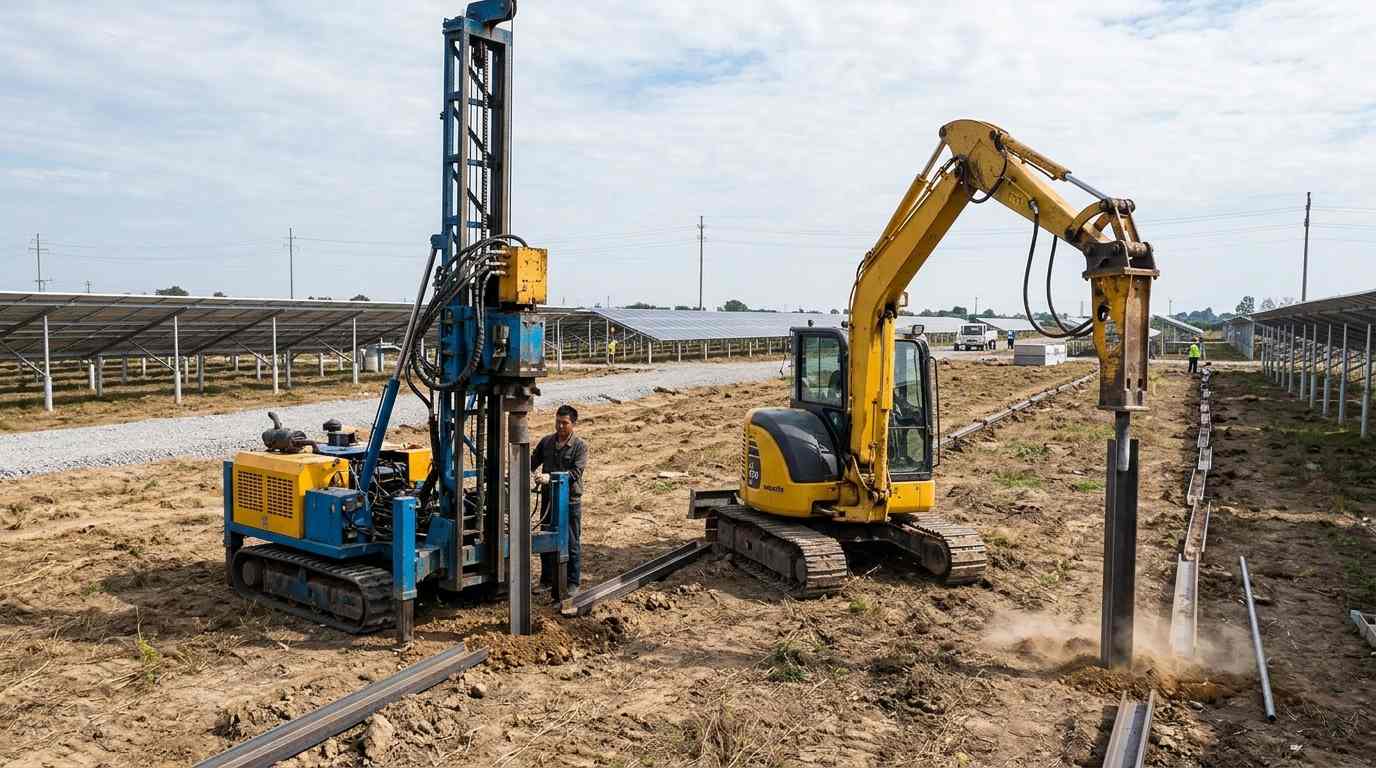
Two ways to install PV foundation piles: dedicated platform vs. excavator-mounted impact tool
A solar farm pile driver is a dedicated piling platform: a crawler or wheeled chassis carrying a vertical mast, a hydraulic impact unit, feed and clamping hardware, and operator controls. Everything — alignment, plumb, driving depth, cycle time — is engineered around one job: installing large volumes of PV foundation posts at uniform spacing.
A hydraulic hammer (also called a hydraulic impact hammer or breaker) is the percussive tool on its own. It bolts onto the arm of an excavator or similar carrier, and the carrier provides positioning, down-force, and mobility. The hammer generates the blows; the carrier does everything else.
Key distinction: The hammer is a component; the pile driver is a complete system. Comparing them is really comparing "a dedicated piling machine" against "a general-purpose carrier plus a piling tool."
2. How Each One Drives a Pile
Both approaches use hydraulic percussive energy to advance a steel post into the ground, but the mechanics around the blow differ:
Dedicated platform: The mast holds the post vertical, the feed system presses it, and the impact unit delivers blows at the top or along the post — plumb and depth are controlled by the machine, not the operator's eye.
Excavator-mounted hammer: The operator swings and presses the carrier arm while the hammer strikes. Positioning quality depends heavily on operator skill, and the geometry of a carrier arm is less suited to holding a long post perfectly plumb.
3. Head-to-Head Comparison
Factor
Dedicated PV pile driver
Excavator + hydraulic hammer
Plumb accuracy
Mast-guided; consistent across thousands of posts
Operator-dependent; drifts over a long run
Driving speed
High — engineered cycle time, auto-feed
Slower — repositioning between posts
Post length capacity
Tall mast handles long posts
Limited by carrier arm reach
Terrain ability
Crawler chassis built for uneven solar fields
Depends on carrier; heavier ground pressure
Setup flexibility
Purpose-built for one job class
Carrier doubles as general excavation kit
Labor demand
Small crew; machine holds precision
Skilled operator critical to quality
4. Impact on Installation Efficiency
On utility-scale sites, efficiency is measured in piles per hour across a multi-hundred-megawatt parcel. Purpose-built platforms win on three levers:
Cycle time: Mast-guided feed and clamping removes the reposition-and-aim step between posts, which is where carrier-mounted setups lose the most time.
Consistency: Uniform plumb and depth mean the module-mounting crew downstream hits no surprises — no re-drilling, no shimming.
Terrain uptime: A crawler chassis designed for soft, ungraded solar fields keeps working after a heavy carrier starts rutting the site.
Industry field experience indicates that dedicated foundation equipment can complete professional foundation work up to roughly 60% faster than improvised carrier-mounted setups — a gap that compounds into schedule risk and cost across a large PV build.
5. When the Dedicated Pile Driver Wins
Utility-scale PV with thousands of uniform posts — the high-volume, high-consistency sweet spot.
Long posts and deep embedment, where mast height and feed force matter.
Soft or ungraded terrain where a crawler chassis keeps working and a heavy carrier does not.
Projects with tight construction windows and schedule penalties.
Crews with limited specialist operators — the machine, not the operator, holds the quality.
6. When the Hydraulic Hammer Setup Wins
Small or scattered jobs — a few posts here and there, where mobilizing a dedicated platform is overkill.
Contractors who already own an excavator and need piling capability for occasional work.
Sites where the carrier must double for trenching, cable-route prep, or general earthworks.
Budget-constrained pilots and small commercial rooftops or distributed installs.
Retrofit and repair work with low volume and irregular post locations.
7. Cost and Total Ownership
The capital comparison is not as one-sided as it first appears. An excavator plus hammer spreads the cost because the carrier is a general-purpose asset, while a dedicated platform is single-purpose. But on a real PV build, compare cost-per-pile, not purchase price:
Cost element
Dedicated platform
Carrier + hammer
Upfront capital
Higher, single-purpose
Lower if carrier is owned
Labor per pile
Lower — fast, consistent cycle
Higher — slower, skill-dependent
Rework risk
Minimal — machine-controlled plumb
Real — bent or off-plumb posts
Versatility
Piling only (some 3-in-1 units add drilling)
Carrier serves many tasks
Verdict: For large solar builds, the dedicated platform usually wins on total cost of ownership despite the higher invoice. For small or mixed fleets, the carrier-plus-hammer setup keeps capital flexible. Many contractors standardize on one solar piling equipment OEM factory for both configurations.
8. How to Choose for Your Site
Your situation
Recommended approach
Utility-scale, 100+ MW, uniform terrain
Dedicated crawler platform; speed and consistency dominate.
Distributed / commercial, mixed tasks
Owned carrier plus hammer; capital stays flexible.
Mixed soil and rock across the parcel
3-in-1 platform (ram + down-the-hole + auger) instead of either single tool.
Assuming the hammer alone is "the machine" — a hammer without a mast and feed system cannot hold long PV posts plumb at volume.
Comparing purchase prices across different job types — a carrier is multi-use, a platform is single-use; the fair metric is cost-per-pile.
Underestimating operator skill on carrier-mounted setups — quality and speed both hinge on it.
Ignoring terrain — a heavy carrier can rut soft solar fields and stall the whole build.
Forgetting rock — if any part of the site hits bedrock, plan for down-the-hole drilling rather than forcing either impact method.
10. Frequently Asked Questions
Q: Solar farm pile driver vs hydraulic hammer — which is better for PV sites?
For utility-scale PV, a dedicated pile driver is better: its mast and feed system hold posts plumb at volume, cycles faster between posts, and crawls terrain a heavy carrier cannot. A hydraulic hammer on an excavator suits small, scattered, or mixed-task jobs where carrier flexibility matters more than volume consistency.
Q: Can I use a hydraulic hammer on an excavator to drive solar piles?
Yes, and many contractors do for small or occasional work. The hammer bolts to the carrier arm and strikes the post. The trade-offs are operator-dependent accuracy, slower cycle time between posts, and limited capacity for long posts — acceptable at low volume, costly at utility scale.
Q: How much faster is a dedicated platform than a carrier-mounted hammer?
Field experience indicates dedicated foundation equipment can complete professional foundation work up to roughly 60% faster than improvised carrier-mounted setups, mainly by eliminating the reposition-and-aim step between posts and holding consistent plumb without rework.
Q: Who builds solar piling equipment for both setups?
Both dedicated platforms and matched hammer tooling are built by specialized piling-equipment manufacturers. When choosing a solar piling equipment manufacturer or supplier, verify factory credentials, certifications (CE, ISO9001), post-size compatibility, and after-sales coverage. China-based OEM factories such as TeZhong supply PV foundation piling machines and 3-in-1 platforms worldwide, exporting to contractors in Europe, the Middle East, Africa, and Southeast Asia.
Choosing between a pile driver and a hydraulic hammer?
TeZhong Machinery is a China-based solar piling equipment manufacturer and supplier (CE & ISO9001 certified, 15+ years, OEM-capable) building dedicated PV foundation platforms and ram/DTH/auger 3-in-1 machines with 24/7 technical support. As a direct factory we configure to your post profile, terrain, and project scale — share your site details for a recommendation.
TZ
TeZhong Machinery Engineering Team
Anhui TeZhong Machinery Technology Co., Ltd. — a direct PV piling equipment, guardrail post driver, and down-the-hole (DTH) drilling rig supplier / OEM factory. Also builds air compressors. CE & ISO9001 certified, 15+ years, global export.





 Jaringan IPv6 didukung